
자료실
Human IgG subclasses (IgG1, IgG2, IgG3, IgG4)
작성자 : ybiologics
등록일 : 2026.07.01조회수 : 846
Human IgG subclasses (IgG1, IgG2, IgG3, IgG4)
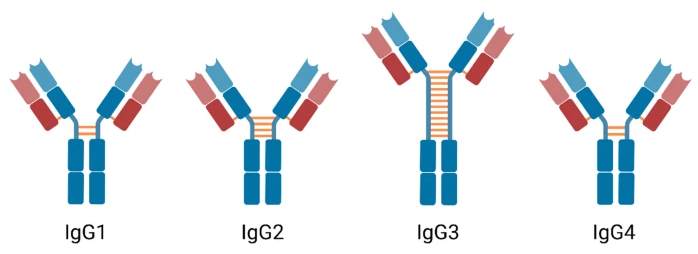
That discovery led to the IgG subclass system we rely on today: IgG1, IgG2, IgG3, and IgG4, named in order of decreasing serum abundance.
Although these subclasses share a common overall structure, they differ in the amino acid sequences of their heavy chains, resulting in distinct biological and effector functions.
Consequently, selecting the appropriate IgG subclass is a critical step in designing a therapeutic antibody, as it largely determines its mechanism of action.
IgG1: Strong Fcγ receptor (FcγR) and C1q binding → robust ADCC and CDC → the standard subclass for oncology therapeutics (e.g., trastuzumab, rituximab)
IgG2: Limited FcγR engagement → an emerging scaffold for co-stimulatory agonist antibodies (e.g., CD40, 4-1BB)
IgG3: The most potent effector subclass in vitro, but its short serum half-life (~7 days) has limited its therapeutic application.
IgG4: Minimal effector function → preferred for immune checkpoint inhibitors and allergy/immune-mediated diseases (e.g., pembrolizumab, dupilumab)