
자료실
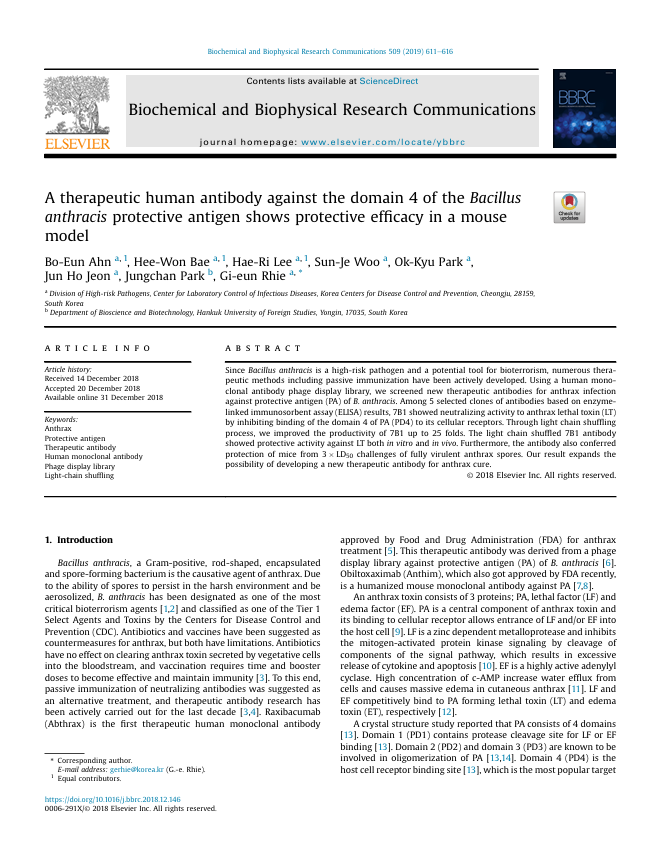
[Citation] A therapeutic human antibody against the domain 4 of the Bacillus anthracis
작성자 : ybiologics
등록일 : 2026.03.26조회수 : 465
Developers need evidence to plan successful experiments. Our client "Korea Centers for Disease Control and Prevention" makes it easy by displaying product citations directly on their pages - so scientists can quickly see how products have bee used in published work.
The Ymax-ABL Library (Y-Biologics, Korea) was used for phage scFv (single-chain variable fragment) biopanning against PA (Green CrossCo, Korea). The library was subjected to 3 rounds of panning process, and binding specificities were identified by enzyme-linked immunosorbent assay (ELISA) for each round of selection as pre viously described [21]. The selected monoclonal phage-scFv clones were converted to human IgG genes using N293F vector (Y-Biologics, Korea), and expressed in HEK293F cells to generate full length human IgG. Recombinant antibodies were purified by protein A affinity chromatography. Concentrations of purified antibodies were measured by absorbance at 280nm (NanoDrop, ThermoFisherScientific). Light chain (LC) shuffling was performed to improve the affinity and productivity of 7B1. DNA fragments from another phage-scFv library gene rated against a human cytosolic protein (Y-Biologics, Korea) were cleaved with BstXI and ligated into the 7B1 LC DNA backbone which was cleaved with the same restriction enzyme to generate LC shuffling library of 7B1. Monoclonal phage-scFvclones of high affinity for PA were selected through 3-rounds of biopanning process, and converted into human IgG form as described above. The binding affinity of antibodies to PA were analyzed by Bio-Layer interferometry (OctetQKe, ForteBio Inc.).
Check out how their projects are presented with our web site here: https://ybioservice.com
2.3. Screening, light-chain shuffling, and binding of antibodies
The Ymax-ABL Library (Y-Biologics, Korea) was used for phage scFv (single-chain variable fragment) biopanning against PA (Green CrossCo, Korea). The library was subjected to 3 rounds of panning process, and binding specificities were identified by enzyme-linked immunosorbent assay (ELISA) for each round of selection as pre viously described [21]. The selected monoclonal phage-scFv clones were converted to human IgG genes using N293F vector (Y-Biologics, Korea), and expressed in HEK293F cells to generate full length human IgG. Recombinant antibodies were purified by protein A affinity chromatography. Concentrations of purified antibodies were measured by absorbance at 280nm (NanoDrop, ThermoFisherScientific). Light chain (LC) shuffling was performed to improve the affinity and productivity of 7B1. DNA fragments from another phage-scFv library gene rated against a human cytosolic protein (Y-Biologics, Korea) were cleaved with BstXI and ligated into the 7B1 LC DNA backbone which was cleaved with the same restriction enzyme to generate LC shuffling library of 7B1. Monoclonal phage-scFvclones of high affinity for PA were selected through 3-rounds of biopanning process, and converted into human IgG form as described above. The binding affinity of antibodies to PA were analyzed by Bio-Layer interferometry (OctetQKe, ForteBio Inc.).